AI crawler access
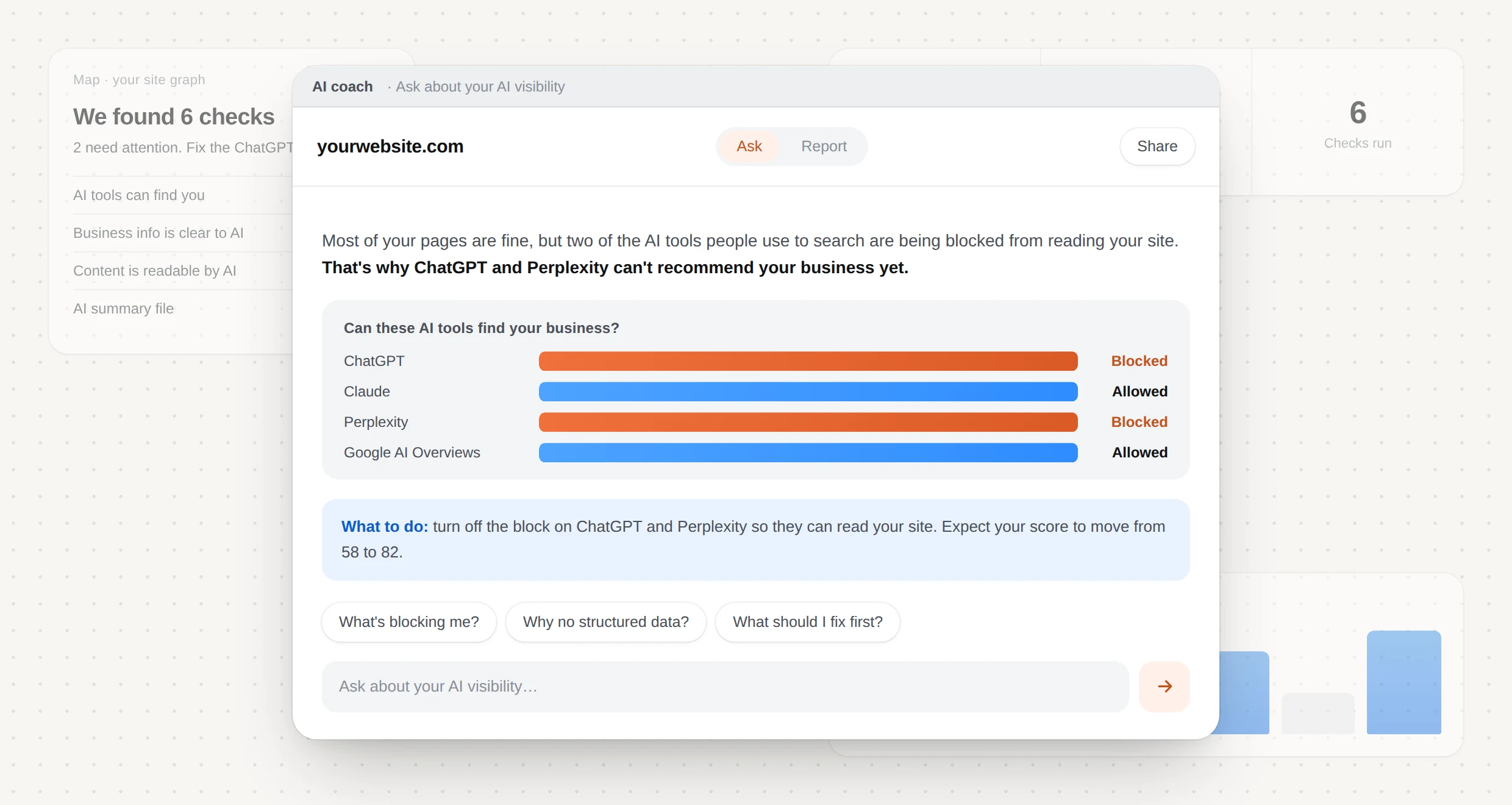
Your robots.txt file can allow or block specific AI crawlers like GPTBot, ClaudeBot and PerplexityBot. If they are blocked, those tools cannot read your site at all.
More customers are asking AI tools instead of Google before they call a business. Paste your website below and we will check whether AI tools can read, understand and cite it, then hand you a plain-English fix list.
Takes about 15 seconds. We check your public robots.txt, structured data and page markup, nothing is installed on your site.
Every check comes with a plain-English breakdown you can act on, like this sample report.
We are putting your report together.
Search engines and AI tools like ChatGPT, Perplexity and Gemini find and understand websites differently than a person browsing does. This is what we look at.
Your robots.txt file can allow or block specific AI crawlers like GPTBot, ClaudeBot and PerplexityBot. If they are blocked, those tools cannot read your site at all.
Structured data (JSON-LD schema) tells AI tools exactly what your business is, what you offer and where you are located, in a format they can parse instantly.
Most AI crawlers read the raw HTML your server sends and do not run JavaScript. If your content only appears after the page loads, they may see a blank page.
An emerging standard that gives AI tools a clean, plain-language summary of your site. Optional today, but increasingly common on AI-citation-ready sites.
A sitemap helps crawlers, including AI crawlers, discover every page on your site instead of only the ones they happen to find through links.
A clear title tag, meta description and a single H1 heading give both search engines and AI tools an unambiguous summary of what the page is about.
When someone asks ChatGPT or Perplexity to recommend a med spa, a contractor or a dentist near them, the AI can only mention businesses it can actually read and understand. A site that AI tools cannot access is invisible in those answers, no matter how good the business is.
This tool checks AI crawler access. A separate free audit checks the fundamentals Google itself looks at: titles, headings, speed signals and more.
Run the Free SEO AuditStill curious how this connects to your website and SEO? Ask us directly.
It is a 0-100 score based on six technical checks that determine whether AI tools like ChatGPT, Perplexity and Gemini can crawl, read and cite your website. A higher score means fewer barriers stand between your business and an AI-generated answer.
It overlaps with SEO but is not identical. Traditional SEO focuses on ranking in Google's search results. AI visibility focuses on whether AI crawlers can access your content at all, and whether it is structured clearly enough for an AI tool to summarize accurately. Both matter, and they reinforce each other.
No tool can guarantee that, including this one. Ranking in AI answers depends on many of the same fundamentals as SEO: clear content, credibility signals and the technical access covered in this report. Fixing what shows up here removes the barriers standing between your site and those answers. It is not a guarantee of appearing in any specific response, but it puts your site in the running instead of ruling it out.
It is a plain-text file, similar in spirit to robots.txt, that gives AI tools a short, structured summary of what your site offers. It is an emerging convention rather than an official standard, so it is one signal among several, not a silver bullet on its own.
No. Most of what shows up in this report is a configuration change, not custom development. On Wix Studio, Squarespace, Shopify or WordPress it is usually quick to fix once you know what to change. If you would rather not deal with it, we can handle it for you.
Yes. We only use your details to send your report and follow up once about it. No newsletters, no sharing with third parties.
Book a short call. We will walk through your report, explain what matters most for your business, and map out what to fix first.